Written by MrHamza, Credit & Money Basics Educator
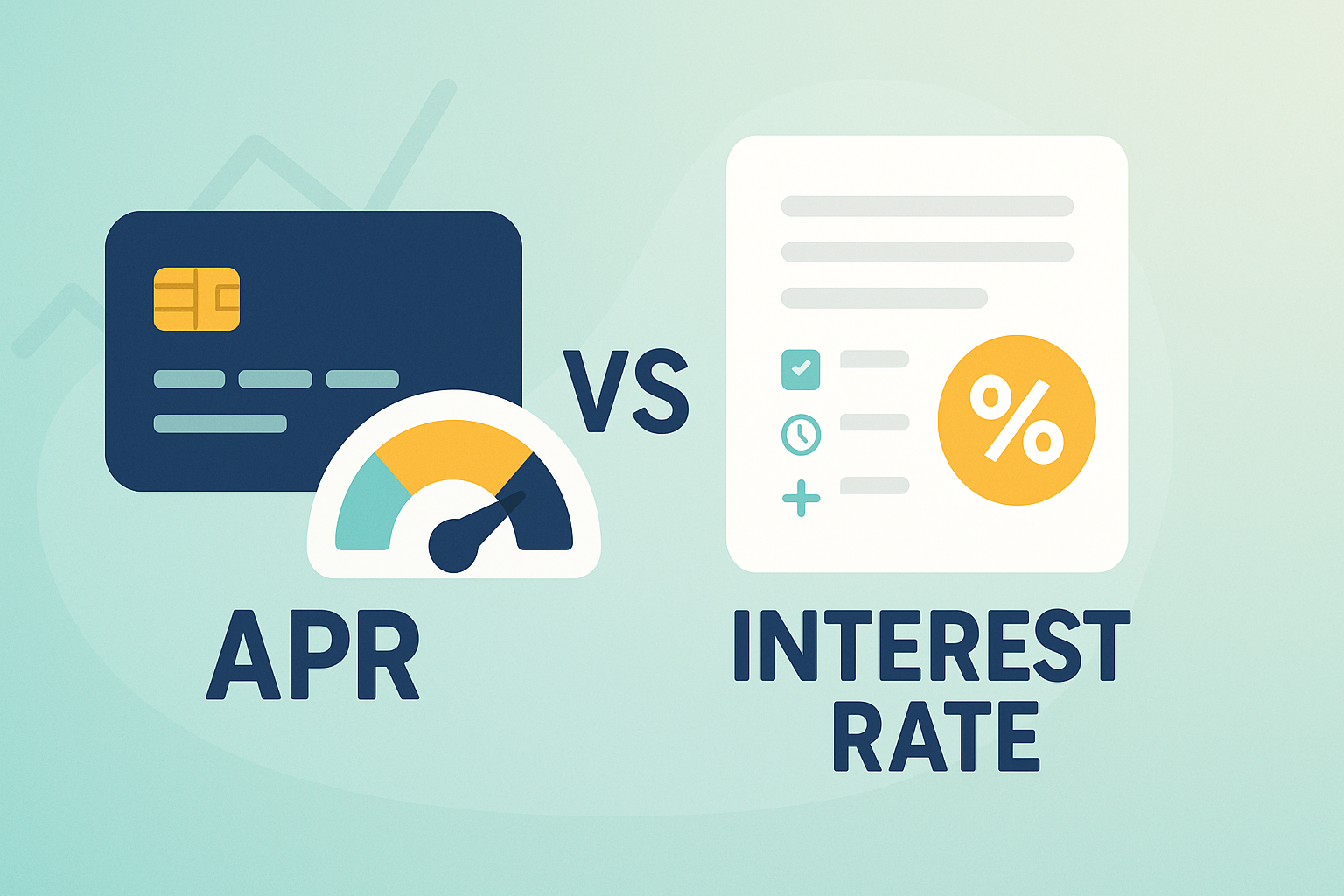
Today subject is about the comparison between APR vs Interest Rate On Credit Cards. “Is APR the same as the interest rate… or not?”
If you’ve ever tried to read a credit card offer, you’ve probably seen both terms tossed around like they’re the same thing. Some blogs use them interchangeably. Other sites say they’re totally different. No wonder it feels confusing.
Here’s the simple truth:
- On credit cards, “APR” and “interest rate” are usually used to mean the same thing.
- In the broader loan world (mortgages, car loans, personal loans), APR is bigger than the interest rate because it also includes certain fees.
In this guide, I’ll explain:
- What “interest rate” really means on a credit card
- What APR means and where it comes from
- When APR and interest rate are the same, and when they’re not
- How your card actually calculates interest with real numbers
All using plain English, not lawyer-speak.
1. Quick Answer: APR vs Interest Rate (Credit Card Version)
Let’s start with the straight-to-the-point version:
- Interest rate = the price you pay to borrow money, as a percentage of what you owe.
- APR (Annual Percentage Rate) = that price, expressed as a yearly rate.
The Consumer Financial Protection Bureau (CFPB) explains that a credit card’s interest rate is the price you pay for borrowing money, and for credit cards this is typically stated as a yearly rate called the APR.
So for credit cards:
Your “interest rate” and your APR are generally the same number, just described differently.
The term “APR” becomes more important (and different) when you’re looking at other loans, like mortgages and auto loans, where APR often bundles in some fees as well.
We’ll come back to that, but first, let’s get clear on how a credit card actually uses that number.
2. What “Interest Rate” Means on a Credit Card

On a credit card, your interest rate is:
- The percentage the card company charges you for borrowing money
- Based on how much you owe and how long you owe it
For credit cards, this is usually:
- Stated as a yearly rate (APR)
- Then converted into a daily rate behind the scenes
Example of daily rate math (similar to what banks show in their guides):
If your APR is 16%, the daily rate is roughly:
16% ÷ 365 ≈ 0.044% per day
A real bank example shows that at 16% APR, a $500 balance racks up about $0.22 in interest per day, adding up to about $6.60 in 30 days if you don’t make new purchases.
So when you see “interest rate” or “APR” on your card:
- It tells you how fast your debt can grow if you don’t pay it off.
3. What APR Means (And Why the Law Cares About It)
APR stands for Annual Percentage Rate.
It’s meant to be a standardized way to show the cost of credit per year, so you can compare cards more easily. The US Truth in Lending Act (TILA) requires lenders to disclose the cost of credit both:
- As a dollar amount (finance charge)
- And as an annual percentage rate (APR)
For credit cards:
- The APR is usually just the interest rate expressed annually.
- For other loans (like mortgages and car loans), APR usually includes certain upfront fees or costs too, so APR can be higher than the simple interest rate.
That’s why:
- On a credit card offer, “interest rate” and “APR” are mostly twins.
- On a mortgage ad, “interest rate” and “APR” can be very different numbers.
4. APR vs Interest Rate: When Are They the Same? When Are They Different?
Let’s break it down by product.
On Credit Cards
Most major issuers and educational sites explain it this way:
- For credit cards, the APR and interest rate are usually the same thing.
Why? Because with “open-end” credit like credit cards, certain fees (like late fees, penalty fees, etc.) often aren’t bundled into the APR number. The APR mainly reflects:
- The periodic interest rate (monthly/daily)
- Annualized, so it’s easier to compare
So when you see:
- Purchase APR: 24.99%
- Interest on purchases: 24.99%
Those are not two different costs — that’s one cost, described two ways.
On Loans (Car, Mortgage, Personal)
For “closed-end” loans like mortgages or car loans:
- The interest rate is just the rate charged on the principal.
- The APR includes:
- The interest rate
- Certain required fees and costs
The CFPB explains it this way: the APR is a measure of the interest rate plus certain additional fees, giving you a more complete price of borrowing.
So on a mortgage ad, you might see:
- Interest rate: 6.25%
- APR: 6.75%
That 0.5% difference is telling you, “when we include lender fees and some other costs, the real yearly cost behaves more like 6.75%.”
5. How Credit Card Interest Is Actually Calculated (Real Numbers)

Even though APR is a yearly number, credit cards calculate interest much more frequently — usually daily, based on your average daily balance.
Here’s the usual process (exact details vary by issuer):
- Convert APR to a daily periodic rate
- Daily rate = APR ÷ 365
- Calculate average daily balance
- Add up your balance for each day in the billing cycle
- Divide by the number of days in the cycle
- Multiply:
- Average daily balance × daily rate × number of days in cycle
Let’s do a real example.
Say:
- APR = 24%
- Daily rate ≈ 24% ÷ 365 ≈ 0.06575% per day
- Average daily balance for the month = $1,000
- Billing cycle length = 30 days
Daily interest:
- $1,000 × 0.06575% ≈ $0.66 per day
Interest for the month:
- ≈ $0.66 × 30 ≈ $19.70
So if you:
- Start the month with $1,000
- Don’t make new purchases
- Don’t pay anything
- APR is 24%
You’ll owe roughly $1,019.70 at the end of the cycle.
That’s why credit card interest grows quickly at today’s rates.
According to CFPB data, average APRs on cards that actually charge interest have nearly doubled over the past decade, from about 12.9% in late 2013 to about 22.8% in 2023.
So the math hurts more than it used to.
6. Variable APR: Why Your Rate Moves When the Fed Moves
Most credit card APRs are variable APRs:
- They’re linked to a benchmark like the prime rate
- The issuer adds a “margin” based on your credit profile
Formula looks something like:
Variable APR = Prime Rate + Margin
When the Federal Reserve changes its benchmark rate, banks update their prime rate, and then your variable credit card APR usually moves in the same direction.
That’s why:
- Your APR can go up even if you didn’t do anything “wrong”.
- In high-rate years, carrying a balance is especially painful.
The key point:
- APR = interest rate (for cards)
- Variable = “this number may change when the broader economy shifts”
7. Where to Find APR & Interest Info on Your Card: The Schumer Box

Every credit card offer has a standardized disclosure table — the Schumer box — that lists:
- APRs (for purchases, balance transfers, cash advances, penalty situations)
- Key fees (annual fee, foreign transaction fee, balance transfer fee, etc.)
This box is required under the Truth in Lending Act to make it easier to compare offers.
In the Schumer box, APR and interest rate will typically appear as:
- “APR for Purchases: 19.99%”
- “APR for Balance Transfers: 0% introductory APR for 12 months, then 22.99%”
- “APR for Cash Advances: 29.99%”
You almost never see a separate “interest rate” number. That’s because, again:
For a credit card, the APR is the interest rate expressed as a yearly percentage.
If you learn to read the Schumer box, you’ve basically learned to read the true cost of the card.
8. Real-Life Examples: How APR and Behavior Interact
Let’s look at a couple of situations.
Example 1: Same APR, Different Habits
Two people have the same card:
- APR: 24%
- Same credit limit
Person A:
- Uses the card
- Pays the balance in full every month
- Result: pays $0 in interest
Person B:
- Uses the card
- Always carries around $1,500 from month to month
Using a rough yearly estimate:
- 24% of $1,500 ≈ $360 per year in interest (assuming balance stays around that level)
Same APR, totally different outcome.
You’re not charged interest just for having a card — you’re charged for carrying a balance.
Example 2: Different APRs, Same Balance
Two different cards:
- Card LowAPR: 18% APR
- Card HighAPR: 28% APR
Both have a $2,000 balance carried for about a year.
Estimated annual interest cost:
- 18% of $2,000 = $360
- 28% of $2,000 = $560
Difference: $200 more in interest in one year just because of a 10-point higher APR.
So when someone says, “Eh, 18%, 24%, what’s the difference?”
The difference is hundreds of dollars over time if you’re not paying in full.
9. How to Actually Use APR vs Interest Rate When You’re Comparing Cards
When you’re shopping for a credit card, here’s how to make sense of it all:
- Look at the Purchase APR first
- This is what matters if you will ever carry a balance.
- Lower is better, especially in a high-rate world.
- Remember: “interest rate” = APR for cards
- If a site talks about “interest rate,” look at the APR number in the Schumer box.
- Don’t worry if they use the words loosely; the number you care about is that APR.
- If you always pay in full
- APR matters less because you won’t be charged interest on purchases (thanks to the grace period) if you pay the statement balance on time.
- For you, rewards, fees, and perks might matter more.
- If you sometimes carry a balance
- APR is huge. High APR + long-standing balance = expensive.
- A simpler card with a lower APR can be better than a flashy rewards card.
- For other loans (car, mortgage, personal)
- Compare APR, not just the interest rate, because APR gives you the fuller picture including certain fees.
10. Quick FAQ: APR vs Interest Rate on Credit Cards
Q1: For my credit card, do I need to care about both APR and interest rate separately?
For most credit cards, no. They’re effectively the same number. Just focus on the APR in your card agreement — that’s the interest rate expressed as a yearly percentage.
Q2: Why does my APR say “variable”?
Because it can move up or down based on a benchmark like the prime rate, which follows the Federal Reserve’s decisions. When the Fed raises rates, variable APRs tend to go up; when it cuts, they may go down.
Q3: Does APR include my annual fee or late fees on a credit card?
For credit cards, APR generally reflects the interest rate, not every possible fee. That’s different from some loans, where APR includes certain fees. You should still check the fee section of the Schumer box separately.
Q4: If I pay in full every month, does my APR matter?
If you truly pay your full statement balance on time every month, you typically won’t pay interest on purchases, regardless of APR. But APR becomes very important the moment you start carrying a balance or doing cash advances.
Q5: Why are credit card APRs so high compared to other loans?
Cards are unsecured (no collateral like a house or car), very flexible, and riskier for lenders. CFPB and Federal Reserve data show that average credit card APRs are now in the 20%+ range, far above many other types of consumer loans.
Final Takeaway
For credit cards:
- APR and interest rate are basically twins — both describe how expensive it is to borrow on that card.
- APR is the number you’ll see in your Schumer box and card agreement.
- The real danger isn’t the term itself, it’s:
- A high APR
- Combined with a balance that sits there for months
If you:
- Understand your APR
- Know how it’s applied
- Make a plan to either pay in full or pay down balances aggressively
…you’re already ahead of most people swiping plastic every day with no idea how the numbers work.