Quick Answer
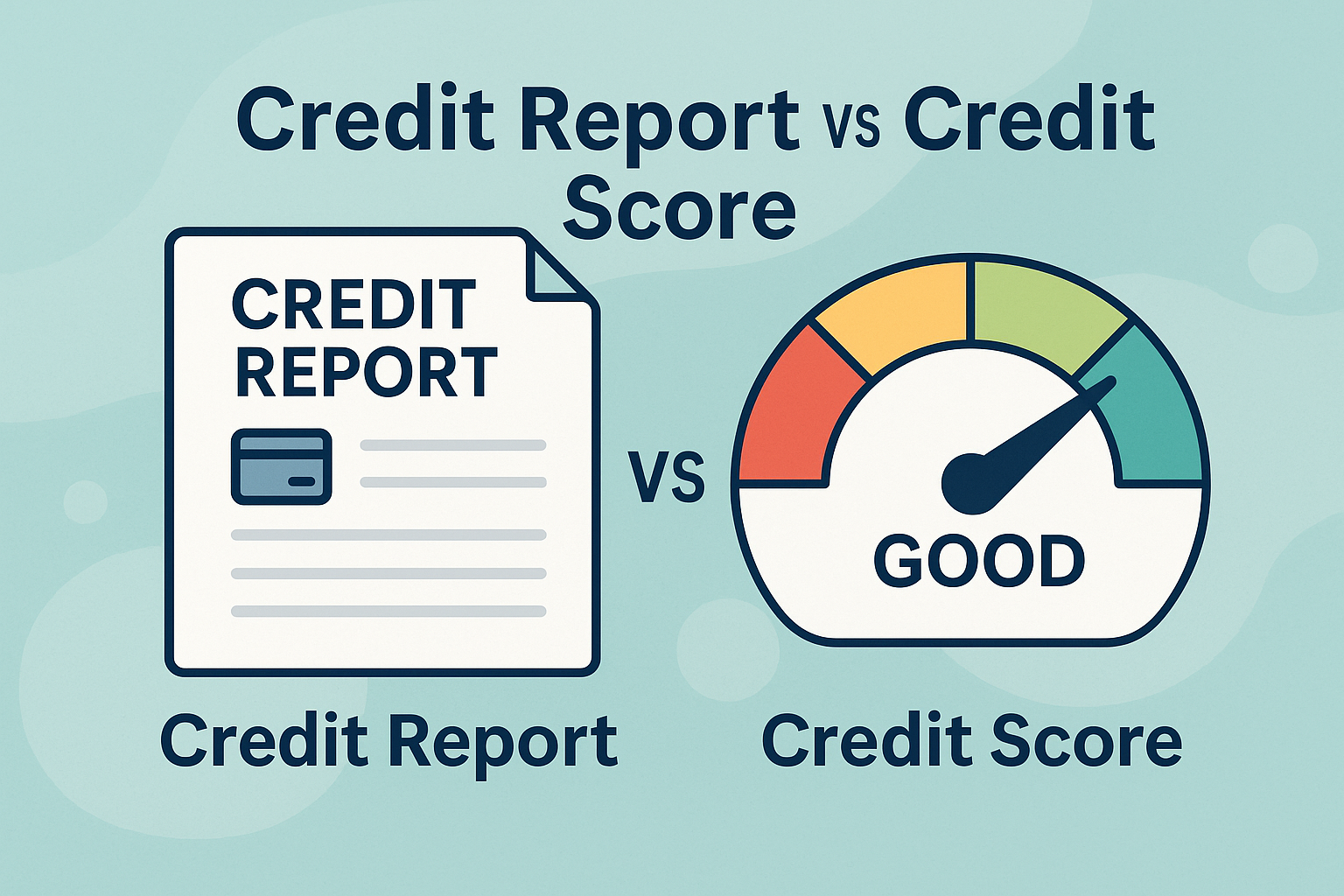
Credit report = your full credit history — a detailed record of every account, balance, payment, and negative item compiled by the credit bureaus.1
Credit score = a three-digit number that a scoring model calculates using the information in your credit report, to summarize your credit risk at a glance.2
Here is why that matters: your credit score does not exist on its own. It is calculated from the data in your credit report. If something inaccurate is sitting on your report — a payment marked late that you actually paid on time, a collection account that is not yours, a balance reported incorrectly — that wrong data feeds directly into your score. Chasing a higher score without first checking the accuracy of your report is like trying to improve your GPA without knowing which class is dragging it down.
This guide explains what each one is, how they are different, how they work together, and what to actually do with that knowledge as a beginner.
What Is a Credit Report?
A credit report is a detailed record of your credit activity, compiled by credit reporting companies known as credit bureaus. In the U.S., the three major bureaus are Equifax, Experian, and TransUnion.1 Each bureau maintains its own version of your report, and they are not always identical — lenders do not always report to all three.
What your credit report typically includes
- Account information: credit cards, auto loans, student loans, mortgages, and other credit accounts
- Balances and limits: current balance, credit limit, or original loan amount
- Payment history: whether each payment was on time or late, and how late (30, 60, 90+ days)
- Negative items: collections, charge-offs, and similar entries if applicable
- Public records: bankruptcy filings if applicable
- Inquiries: a record of who has accessed your report and when
- Personal information: your name, addresses (current and previous), and employer as reported
What Is a Credit Score?
A credit score is a number produced by a scoring model that reads the information in your credit report and converts it into a single risk estimate. The FTC explains that scores are based on credit report information and are used in lending decisions — including whether to approve you and on what terms, such as interest rates.2
In simple terms: the scoring model is a formula that looks at your report and asks, “Based on this person’s history, how likely are they to repay a new debt?” The answer comes back as a three-digit number.
Key things to know about credit scores
- Many popular scoring models use a 300–850 range, though not all scores use the same scale3
- The two most widely used scoring models are FICO and VantageScore — lenders may use different models and different versions of those models
- You do not have one single credit score — you have many, because each bureau has its own data and each scoring model calculates differently
Credit Report vs. Credit Score: Side-by-Side
| Feature | Credit Report | Credit Score |
|---|---|---|
| What it is | Detailed record of your full credit history | Three-digit number summarizing credit risk |
| Who creates it | Credit bureaus (Equifax, Experian, TransUnion)1 | Scoring models (FICO, VantageScore, and others) |
| What is inside | Accounts, balances, payment history, inquiries, negative items | A calculated number — often 300–8503 |
| Where to get it | AnnualCreditReport.com — the official free source4 | Banks, card issuers, monitoring apps, bureaus — varies by provider |
| How to improve it | Fix errors; pay on time; reduce balances | Score updates as the underlying report data changes — improve the report first |
| How many do you have? | One per bureau (three bureaus = potentially three different reports) | Many — different models and bureaus produce different scores |
How They Work Together
The relationship between your report and your score is a one-way pipeline: your behavior feeds your report, and your report feeds your score.
- Your behavior — paying on time, carrying a balance, applying for new credit
- → gets recorded on your credit report by lenders reporting to the bureaus
- → scoring models read the report and calculate your credit score
Report = the cause. Score = the effect. You cannot directly improve a credit score — you can only improve the report data that the score is calculated from. This is why checking and correcting your report is always the right starting point.
Real-Life Examples
Example A: One late payment, one report entry, one score drop
Imagine you have a clean credit history and a solid score. One month, a payment is 30 days late before you catch it. The lender reports that late payment to the bureaus. It shows up on your credit report first — as a specific entry in your payment history. Then, when your score is next calculated, it reflects that new entry.
Payment history is one of the most significant factors in most scoring models, so even a single late payment can cause a noticeable drop.5 The key detail: the score did not just change on its own — the report changed first, and the score followed.
Example B: Same score, very different stories underneath
Two people can have a similar score — say around 680 — but for completely different reasons:
- Person A: One past late payment from two years ago, but low balances, long account history, and no recent applications
- Person B: No late payments ever, but very high credit card balances relative to their limits, a very short credit history, and several recent applications
The score number looks the same. The reports underneath look very different. Many lenders review both the score and the report details — the score tells them a headline, and the report tells them the story behind it.
Where to Get Your Credit Report
In the U.S., the official free source for credit reports is AnnualCreditReport.com. The FTC describes this as the legitimate official site for obtaining free reports from Equifax, Experian, and TransUnion.4
One important detail: your free credit reports usually do not include your credit score. The report shows the account history and details; the score is usually provided separately by banks, card issuers, bureaus, or monitoring services.
Tips when pulling your reports
- Pull reports from all three bureaus — Equifax, Experian, and TransUnion — not just one. An error may appear on one but not the others, and you can only dispute it with the bureau that shows it
- Download or print copies and save them before reviewing
- Read through every section — accounts, payment history, inquiries, personal information — and flag anything that looks unfamiliar or incorrect
Where to See Your Credit Score
Unlike credit reports, there is no single official free source for all credit scores. Common places where you can see a score include:
- Your bank or credit card issuer: many now show a score inside the app or on your statement — often labeled as an “educational score”
- Credit monitoring apps: typically provide a score based on one bureau’s data, often using VantageScore
- Bureau websites: sometimes offer scores directly, though they may be bundled with paid services
A common mistake beginners make is comparing scores from two different sources and worrying when they are different numbers. That is normal. What matters more than the exact number is the direction over time — and the accuracy of the report underneath it.
What Beginners Should Focus on First
Think of it this way: your credit score is the dashboard warning light. Your credit report is the engine underneath. When something goes wrong, the light tells you something is off — but to actually fix it, you need to look under the hood.
- Pull all three reports from AnnualCreditReport.com4
- Look for errors: accounts not yours, payments incorrectly marked late, duplicate entries, unfamiliar inquiries
- If you find genuine errors, dispute them with the bureau(s) that show the error
- Track the trend over several months — is it going up, down, or staying flat?
- When the score changes, check what changed on your report — usually a balance update, a new account, or a payment status change
- Pay on time consistently and keep credit card balances reasonably low relative to your limits
FAQ
Can I have a credit report but no credit score?
Yes. If you do not yet have enough credit history — or if your accounts are too new or inactive — a scoring model may not be able to generate a usable score. You can have a credit report with some information in it without that being enough for a score to calculate. This is sometimes described as being “credit invisible” or having an “unscorable” file.
I pulled my free report and did not see a score. Is that normal?
Yes, completely normal. AnnualCreditReport.com provides the reports — the detailed account-by-account history. It does not typically provide scores. Scores are available through banks, card issuers, monitoring apps, or bureau services.4
Which do lenders actually look at — my report or my score?
Often both. Most lenders pull a credit report from at least one bureau and use a score derived from that report. The score gives them a fast headline number; the report gives them the detail behind it. For larger credit decisions like a mortgage or auto loan, lenders typically review the report in depth alongside the score.
If I fix an error on my report, will my score go up right away?
Not instantly, but relatively quickly. Once the corrected data is updated on your report, your score should reflect the change the next time it is calculated from that updated report. The timeline depends on how quickly the bureau updates the report and when the scoring model next runs a calculation.
Why does my score change even when I did not do anything?
Because your creditors regularly report updated information to the bureaus — updated balances, payment confirmations, and other account activity. When your report data changes, your score recalculates. A balance that went up on your credit card, for example, can cause a score dip even if you did nothing unusual — because the utilization ratio in your report changed.
Do all three bureaus have the same information on me?
Not necessarily. Lenders are not required to report to all three bureaus, and they do not always do so. One bureau might show an account or a late payment that another does not. This is why pulling all three reports and reviewing them separately is important — especially if you are trying to find and dispute an error.
What to Do Next
The most useful first step for any beginner is simply to pull your credit reports from AnnualCreditReport.com and read through them — all three, not just one. Many people have never done this, and it is often easier than they expect. You are looking for anything that seems wrong: an account you do not recognize, a payment history that does not match your records, a balance that looks off.
Once you know your reports are accurate, tracking your score as a trend over time becomes genuinely useful feedback. A rising score tells you your report data is improving. A falling score tells you something changed — and the report is where you find out what.
The report is the foundation. Everything else — including your score — is built on top of it.
References
-
CFPB. “What is a credit report?” — overview of what credit reports contain and how they are used in decisions.
Source -
FTC. “Credit scores” — explains what credit scores are, that they are based on credit report information, and how they are used in lending decisions.
Source -
CFPB. “What is a credit score?” — general explanation of credit scores, scoring ranges, and how they vary by model.
Source -
FTC. “Free credit reports” — official guidance on obtaining free credit reports through AnnualCreditReport.com.
Source -
myFICO. “What’s in your FICO Score?” — educational breakdown of the factors that make up a FICO score, including payment history as a major component.
Source
Disclosure: Educational content only. Credit reporting and scoring practices vary by bureau, lender, and scoring model. Always verify current information through official sources and your own credit reports