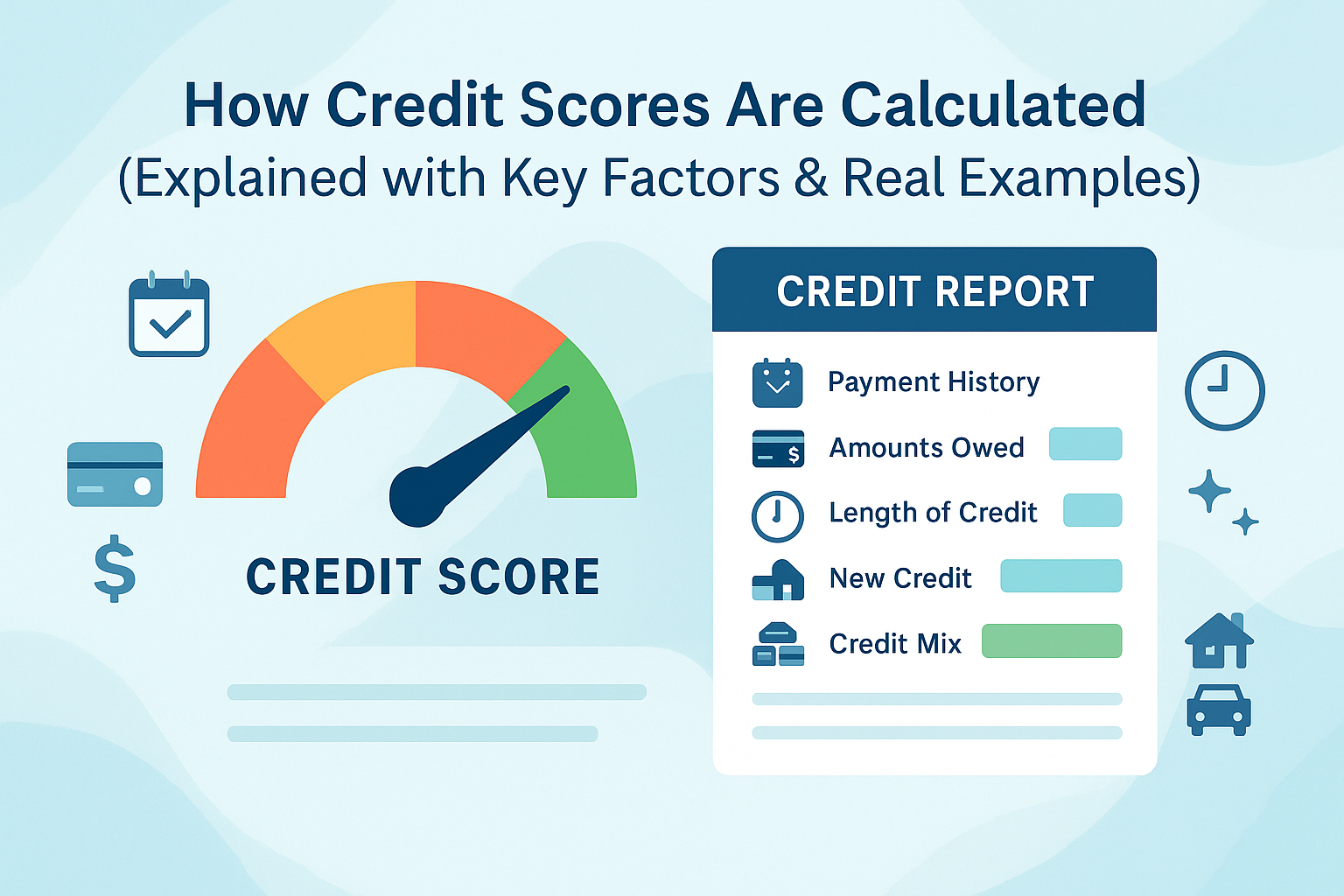
Quick Answer
Credit scores are calculated from the information in your credit reports. Scoring companies such as FICO and VantageScore use different models, but they usually look at the same core factors: whether you pay on time, how much debt you carry, how long you have used credit, how often you apply for new credit, and what types of credit accounts you have.12
| Factor | Approximate FICO weight | Plain-English meaning |
|---|---|---|
| Payment history | 35% | Do you pay your bills on time? |
| Amounts owed | 30% | How much debt are you carrying, especially compared with your limits? |
| Length of credit history | 15% | How long have your accounts been open? |
| New credit | 10% | Have you opened or applied for many accounts recently? |
| Credit mix | 10% | Do you have experience with different types of credit? |
The confusing part is that there is no single universal score formula. FICO, VantageScore, and other scoring models use their own methods. Even so, the same core ingredients show up again and again.
This guide explains how credit scores are calculated in plain English, with examples that show how everyday behavior can affect your score over time.
Big Picture: How Credit Scores Are Built
Credit scores are calculated from data in your credit reports. Those reports are maintained by the three major U.S. credit bureaus: Equifax, Experian, and TransUnion.1
Scoring companies then apply their models to that report data. In simple terms:
- Your lenders report account activity to the credit bureaus.
- The bureaus store that activity in your credit reports.
- Scoring models read your reports and calculate a score.
The CFPB explains that credit scores are based on information in your credit reports, including payment history, unpaid debt, length of credit history, account types, credit use, and recent applications.1
The FICO “Recipe”: 5 Main Factors
FICO does not publish its full formula, but it does share the major categories used in a typical FICO Score and their approximate importance.2
| FICO factor | Approximate weight | Beginner meaning |
|---|---|---|
| Payment history | 35% | Whether you pay accounts on time |
| Amounts owed | 30% | Debt levels and credit utilization |
| Length of credit history | 15% | How long your accounts have been open |
| New credit | 10% | Recent applications and newly opened accounts |
| Credit mix | 10% | Experience with different account types |
These percentages are not a school-grade formula. They are approximate category weights. Your exact score depends on the full picture in your report, not one factor alone.
Payment History: The “Did You Pay on Time?” Factor
Payment history is usually the largest factor in a FICO Score. It looks at whether you have paid past accounts on time and whether your report shows late payments, collections, charge-offs, or bankruptcies.2
What payment history looks at
- Whether payments were made on time
- How late any missed payments were, such as 30, 60, or 90+ days
- How recently the late payment happened
- Whether serious negatives such as collections or bankruptcy appear
Example: One late payment
Imagine you have a credit card that you have paid on time for three years. Then one month, you miss the due date and the payment becomes 30 days late. If the lender reports that late payment, your score can drop because payment history is heavily weighted.
Amounts Owed and Credit Utilization
The “amounts owed” category looks at how much debt you are carrying. For credit cards, one of the most important parts is credit utilization — how much of your available revolving credit you are using.2
Utilization = reported balance ÷ credit limit × 100
Example: High utilization
- Credit limit: $2,000
- Reported balance: $1,600
- Utilization: $1,600 ÷ $2,000 = 80%
High utilization can put downward pressure on your score even when you pay on time, because it may suggest heavier reliance on available credit. The CFPB commonly recommends keeping credit use below 30% of your total limit, with lower generally being better.3
Example: Paying down a card
| Total limit | Balance | Utilization | Meaning |
|---|---|---|---|
| $3,000 | $2,400 | 80% | Very high |
| $3,000 | $900 | 30% | Common guideline level |
When a lower balance is reported to the bureaus, the utilization part of your credit profile can improve. The exact score change varies by profile and scoring model.
Length of Credit History
Length of credit history looks at how long your accounts have been open. FICO says this category makes up about 15% of a typical FICO Score.2
What this factor may consider
- Age of your oldest account
- Average age of all accounts
- How long specific accounts have been open
- How recently certain accounts have been used
Example: Average account age
| Person | Accounts | Approximate average age |
|---|---|---|
| Person A | Card opened 4 years ago; loan opened 3 years ago | 3.5 years |
| Person B | Card opened 6 months ago; store card opened 2 months ago | About 4 months |
Even if both people pay on time, Person A may have an advantage because the credit history is longer. Time is part of the score, and this factor cannot be rushed.
New Credit
New credit looks at recent applications and newly opened accounts. FICO lists this category at about 10% of a typical score.2
A single application is usually not a major problem. But several new applications in a short time can signal higher risk to lenders and may create multiple hard inquiries.
Example: Two approaches
- Person A: applies for one card this year — one hard inquiry, usually a small and temporary effect.
- Person B: applies for six cards in two months — multiple hard inquiries and new accounts may have a stronger effect.
Credit Mix
Credit mix looks at the types of credit accounts you have experience managing. FICO generally puts this category at about 10% of a typical score.2
Common account types
- Revolving credit: credit cards and store cards
- Installment credit: auto loans, student loans, mortgages, and personal loans
You do not need every type of account to have a good score. Credit mix is a smaller factor, and it is not worth taking on debt just to improve this category.
VantageScore: Similar Ingredients, Different Recipe
VantageScore is another major credit scoring model. It uses similar information from your credit reports but groups and weighs factors differently from FICO.4
The exact categories and weights vary by VantageScore version, but the big ideas are familiar: payment history, credit age, utilization, balances, recent credit, and available credit.
What Is Not Directly in the Score Formula?
Many beginners assume a credit score uses more personal information than it actually does. In general, credit scores are based on credit report information — not your full personal life.1
Things that are not directly part of most credit score formulas
- Your income
- Your job title
- Your employer
- Your marital status
- Your race, gender, or religion
- Your debit card usage
- Your savings account balance
Some of these details can matter to lenders in other ways. For example, a lender may ask for your income when you apply. But income is not the same thing as credit score data.
Step-by-Step Example: How Behavior Turns Into a Score
Imagine Maria, a beginner with one credit card, one small auto loan, and two years of credit history.
Month 1: High utilization
- Credit card limit: $1,500
- Reported balance: $1,350
- Utilization: 90%
She pays on time, but the high reported utilization can put downward pressure on her score.
Month 2: Pays the card down
- New reported balance: $450
- New utilization: 30%
When the lower balance is reported, the utilization part of her profile improves. Her score may improve, although the exact number depends on the full report and scoring model.
Month 3: One late payment
- She forgets an auto loan payment.
- It is reported as 30 days late.
Because payment history is heavily weighted, the late payment may hurt more than the earlier utilization change. Over time, clean payment history and lower utilization can help her recover, but the best move is prevention: autopay, reminders, and early contact with creditors if she is struggling.
Different credit behavior can create a different score because the report data changes.
FAQ
Is my score literally 35% payment history plus 30% utilization?
Not exactly. Those percentages are approximate category weights, not a simple school-grade formula. Your actual score depends on the full picture in your credit report and the scoring model being used.2
Can one late payment cause a big drop?
Yes, especially if your report was previously clean. The exact point change varies by profile and scoring model, but payment history is one of the most important scoring areas.
Does checking my own score hurt my score?
No. Checking your own score or report is a soft inquiry and does not hurt your score. Hard inquiries usually happen when you apply for new credit.
Are all credit scores FICO?
No. FICO is widely used, but VantageScore and other scoring models also exist. Different lenders and apps may show different scores because they may use different models, bureaus, or model versions.
Why do I see different scores from different places?
Different score sources may use different credit bureaus, different scoring models, or different model versions. That is normal. Watch your general range and trend over time instead of obsessing over one exact number.
What to Do Next
Start with the two biggest levers: payment history and utilization. Set up autopay for at least the minimum payment so you avoid accidental late payments. Then look at your credit card balances compared with your limits and focus on lowering any card that is sitting high.
After that, be patient. Let good accounts age, avoid unnecessary applications, and do not borrow money just to create a better credit mix. Credit scores are built from patterns, not one perfect move.
The simple version is this: pay on time, keep balances low, apply only when you have a purpose, and check your reports for accuracy. Those habits help the major scoring models see a cleaner credit profile.
References
-
CFPB. “What is a credit score?” — explains what credit scores are, that they are based on credit report information, and what types of factors can affect them.
Source -
myFICO. “What’s in your FICO Score?” — explains the five main FICO Score categories and their approximate weights.
Source -
CFPB. “How do I get and keep a good credit score?” — includes guidance on paying on time and keeping credit use under 30% of total credit limits.
Source -
VantageScore. “Credit scoring 101: factors that affect your VantageScore credit score” — explains VantageScore factor categories and how they differ from FICO-style groupings.
Source
Disclosure: Educational content only. Credit scoring models and lender practices vary. Always verify your specific situation using your own credit reports and official sources.