Key Takeaways
- You don’t have just one score — scores vary by bureau and scoring model.
- Across most models, the biggest wins are: pay on time and keep credit card balances low.
- Check your credit reports regularly and fix errors early, especially before applying for credit or renting.
Quick Answer
A credit score is a three-digit number that tells lenders how likely you are to repay a loan on time. The two biggest things that affect it are whether you pay on time and how much of your credit limit you are using. You do not have just one score — different bureaus and scoring models can show different numbers, and that is completely normal.
Introduction
If you have ever applied for an apartment, a car loan, or a credit card and wondered why you were approved — or not — your credit score was part of that decision. Lenders, and sometimes landlords, use it to quickly judge how likely you are to repay what you borrow.
A lot of people have heard conflicting things about how credit scores work. One of the most common myths is that you need to carry a credit card balance and pay interest to build credit. That is not accurate — what counts is on-time payments and the balances that get reported to the bureaus.
There is also a lot of anxiety around credit scores that is not necessary. They follow a consistent logic, and once you understand what moves them, the path forward is fairly clear. Here is what you need to know.
1) What Is a Credit Score?
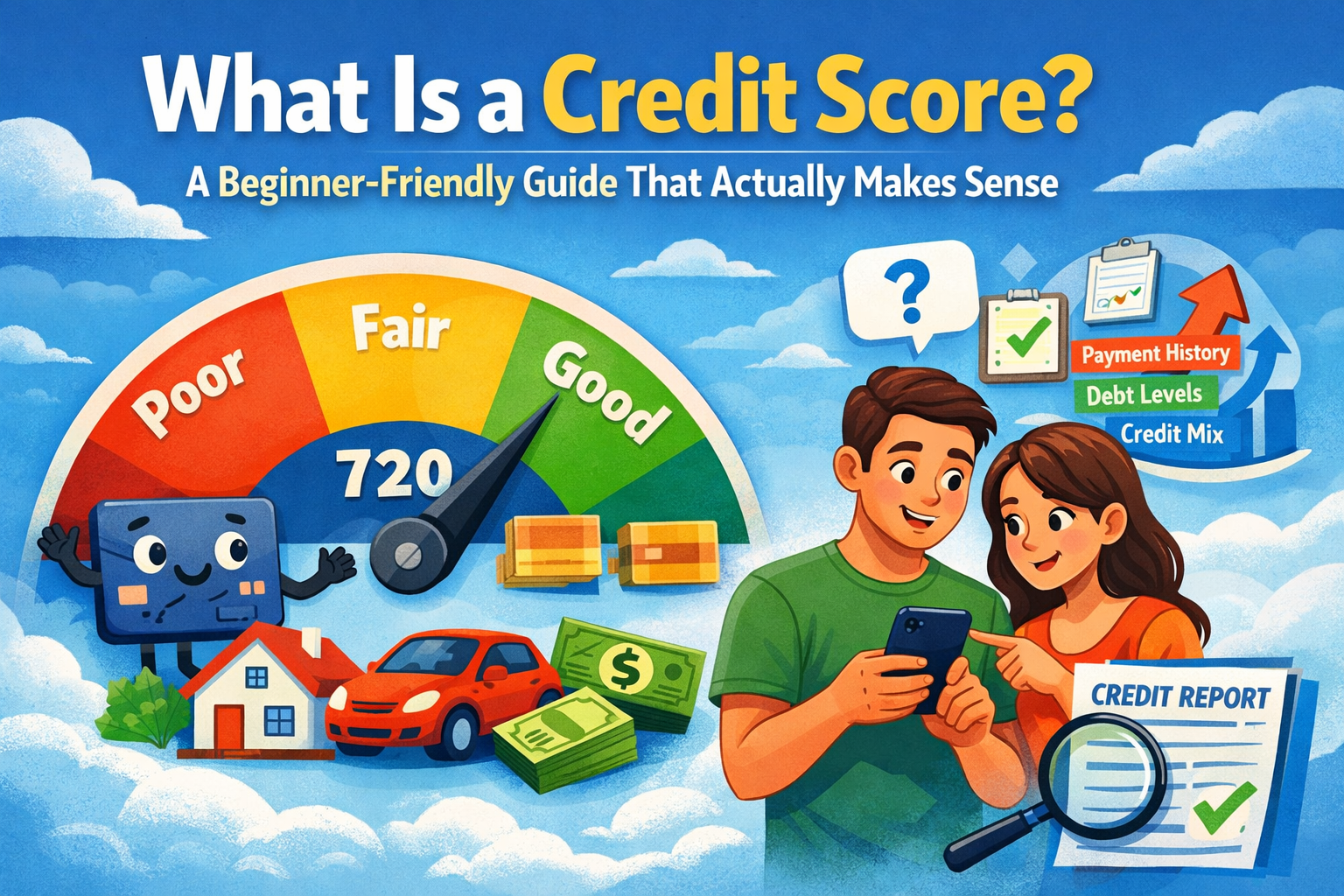
A credit score is a number — typically between 300 and 850 — that scoring models calculate based on the information in your credit report. Lenders use it to decide whether to approve your application, how much credit to offer, and what interest rate to charge.1
In simple terms, it is a snapshot of your borrowing history. It does not measure your income, your savings, or how responsible you are as a person. It only reflects what is in your credit file.
2) Credit Score vs. Credit Report: What Is the Difference?
This is one of the most common points of confusion for beginners.
| Credit Report | Credit Score |
|---|---|
| A detailed file of your accounts, balances, payment history, and inquiries. | A number calculated from your report data by a scoring model. |
| Created by the three main bureaus: Equifax, Experian, and TransUnion. | Produced by scoring companies like FICO and VantageScore. |
| Can differ by bureau because not every lender reports to all three. | Can differ by model, version, and the lender’s specific use case. |
| Check it for errors regularly. | Track it to measure progress — not to obsess over a single number. |
A common mistake beginners make is assuming they have one credit score stored somewhere. In reality, you have many scores, and they can vary depending on which bureau’s data is used and which scoring model does the calculation.2
3) Why You Do Not Have Just One Credit Score
You might check your score on your bank’s app, then check it on a credit monitoring site and see a different number. Both can be correct. Here is why scores differ:
- Different bureaus have different data. Not every lender sends payment information to all three bureaus, so each bureau’s file can look slightly different.
- Different scoring models exist. FICO and VantageScore are the two main companies, and each has multiple versions. FICO alone has dozens of versions used for different purposes — mortgage, auto, credit cards.
- Some lenders use custom scorecards built on top of bureau data, which adds another layer of variation.
The practical takeaway: do not chase a specific number. Focus on the habits that improve your score across almost every model — paying on time and keeping credit card balances low.2
4) What Actually Affects Your Credit Score?
FICO, one of the most widely used scoring models, groups credit factors into five categories. Here is a plain-English breakdown.3
Payment History — The Biggest Factor
Whether you pay your bills on time is the single most important factor in most scoring models. One missed payment — especially if it goes 30 or more days late — can drop your score noticeably. Setting up autopay for at least the minimum payment on every account is one way to protect against accidental late payments. Paying more manually is always an option on top of that.3
Amounts Owed (Credit Utilization) — Fast to Change
This is your credit card balance divided by your credit limit. For example, if your card has a $1,000 limit and your reported balance is $300, your utilization is 30%.
The tricky part: even if you pay your card in full every month, the balance that gets reported to the bureaus — usually your statement balance — is what the scoring model sees. So you could be paying in full and still have high utilization.4
Length of Credit History — Slow to Change
How long you have had credit matters. Older accounts help your score. This is one reason closing your oldest credit card is generally worth thinking through carefully, even if you rarely use it.
New Credit (Hard Inquiries) — Temporary Impact
When you apply for a loan or credit card, the lender typically does a hard inquiry — they pull your credit report. This can temporarily lower your score by a small amount. Multiple applications in a short window can add up. One common approach is to apply for new credit only when there is a clear reason, especially before a big goal like renting an apartment or getting a car loan.2
Credit Mix — Smallest Factor
Credit mix refers to the different types of credit accounts on your report — for example, credit cards (called revolving credit) alongside an installment loan like a car loan or student loan.
Having more than one type of account can contribute a small positive effect to your score. According to myFICO, credit mix is considered in scoring but is not a major factor for most people — especially if there is not much other information on the credit file to go on.3
A common mistake beginners make is opening new accounts specifically to improve their credit mix. In most cases this is not necessary, and it can temporarily lower your score through hard inquiries and a reduced average account age. Credit mix tends to develop naturally over time as you take on different types of credit for real reasons.
5) What Is a “Good” Credit Score?
Most commonly used scoring models range from 300 to 850, but not all models use the same scale. Lenders also set their own approval thresholds, so there is no single universal definition of “good.”1
In the U.S., the official source for free credit reports is AnnualCreditReport.com. Before using any credit report website, make sure you are on the official site and not a lookalike service.
| Score Range | Common Label |
|---|---|
| 300–579 | Poor |
| 580–669 | Fair |
| 670–739 | Good |
| 740–799 | Very Good |
| 800–850 | Exceptional |
Instead of focusing on a label, consistent habits tend to matter more in practice. Scores in the “good” range and above are generally associated with better loan rates, easier approvals, and sometimes more rental options — though this depends on the lender and situation.2
6) A Simple Plan to Improve Your Credit Score
✅ Step 1: Protect Your Payment History
- Set autopay for the minimum payment on every account.
- Pay more manually when possible.
- If a payment is missed, bring it current as quickly as possible — the damage grows the longer it stays unpaid.3
✅ Step 2: Lower Your Credit Utilization
- Pay down card balances before the statement closing date, not just the due date.
- Try to keep reported balances well below your credit limit — especially before applying for anything important.
- Even if you pay in full each month, a high statement balance can still affect your score.4
✅ Step 3: Slow Down on New Applications
- Each new application can trigger a hard inquiry and temporarily lower your score.
- Avoid applying for new credit right before a major goal like renting an apartment or getting a car loan.2
✅ Step 4: Build Credit If You Are Starting from Zero
If you have a thin credit file — little to no credit history — some paths beginners commonly explore include:
- Secured credit cards — you deposit money as collateral and your on-time payments get reported to the bureaus.
- Becoming an authorized user on someone else’s card — the account’s history may appear on your report. This works best if the primary cardholder pays on time and keeps balances low.
- Credit-builder loans offered by some credit unions and community banks — availability varies by location and institution.
The goal with all of these is clean payment history, not accumulating debt.
7) Free Credit Reports and Fixing Errors
How to Check Your Credit Reports for Free
Before you apply for credit or sign a lease, checking your credit reports first is worth the time. In the U.S., the official source for free credit reports is AnnualCreditReport.com. The CFPB notes that weekly online access to reports has been made available.5
You have three separate reports — one from each bureau (Equifax, Experian, TransUnion). Checking all three matters because an error in one will not show up in the others.
How to Fix an Error on Your Credit Report
If something looks wrong — an account you do not recognize, a payment marked late that you paid on time, or outdated information — here is the general process based on CFPB and FTC consumer guidance:6 7
- Write down exactly what is wrong and gather any documents that support your case — bank statements, payment confirmations, or account records.
- File a dispute with the credit bureau showing the error. This can usually be done online, by mail, or by phone.
- Also dispute with the company that reported the information — this is called the data furnisher.
- Keep records of everything — dates, names, confirmation numbers, and copies of anything you send.
8) Why Credit Scores Can Cost Real Money
Here is a concrete example that shows why this matters financially. Imagine two people take out the same $15,000 auto loan for 60 months. The only difference is the interest rate they are offered based on their credit profile:
| Scenario | APR | Monthly Payment | Total Interest Paid |
|---|---|---|---|
| Better credit profile | 6% | ~$290/month | ~$2,398 |
| Weaker credit profile | 14% | ~$349/month | ~$5,951 |
| Difference | — | ~$59/month more | ~$3,552 more |
This example is illustrative only. Actual rates depend on the lender, the market, your full application, and many other factors — not just your credit score. Use this to understand the scale, not to predict a specific offer.
FAQ
Does checking my own credit score hurt it?
Checking your own credit report or score is a soft inquiry and does not affect your score. Hard inquiries — the kind that happen when you apply for credit — can affect your score. If you are unsure which type a lender uses, it is worth asking before they pull your report.2
Do I need to carry a balance to build credit?
No. You do not need to pay interest to build credit. What matters is that on-time payments get reported to the bureaus. Paying your balance in full every month is fine — just be aware that your reported statement balance still affects your utilization.4
Why did my score drop even though I paid on time?
Several things can cause this even when no payments were missed: a higher reported card balance (higher utilization), a recent hard inquiry from a new application, a new account lowering your average account age, or an error in the report worth investigating.6
How long does it take to improve a credit score?
This depends on what is affecting the score. Lowering your utilization can show results within one or two billing cycles. Recovering from a missed payment takes longer — the negative mark stays on your report for a number of years, but its impact typically fades as positive history builds.
What is the difference between FICO and VantageScore?
Both are credit scoring companies that use credit report data to calculate a score. FICO is older and more widely used by lenders for major loan decisions. VantageScore was developed jointly by the three main bureaus. They use similar factors but weigh them differently, which is why your FICO score and VantageScore may not match.2
Can I build credit without a credit card?
Yes. Credit-builder loans and some other financial products are designed for people with no credit history. The key detail to confirm is whether the product reports to the credit bureaus — not all do, so it is worth checking before opening an account.
What to Do Next
Start with your credit reports — not your score. Go to AnnualCreditReport.com, pull all three reports, and look for anything that does not seem right. If everything looks clean, set up autopay on your accounts so no payment slips through. Those two steps put you on solid footing before anything else.
References
-
Consumer Financial Protection Bureau (CFPB). “What is a credit score?” (Ask CFPB)Definition, common score range, and why lenders use scores.
-
CFPB. “Why are there differences between credit scores?” (Ask CFPB) + “Understanding Differences in Credit Scores” reportWhy you may see different scores across bureaus and scoring models.
-
myFICO (FICO). “What’s in my FICO Scores?”FICO category breakdown: payment history, amounts owed, length of history, new credit, and credit mix.
-
CFPB. “Will paying off my credit card balance every month improve my credit?” (Ask CFPB)Reported balances, utilization, and why timing can matter.
-
CFPB. Free credit reports guidance (AnnualCreditReport.com)How to request your credit reports through the official channel; frequency and availability can change over time.
-
CFPB. Disputing credit report errors (consumer guidance)How to dispute errors and what documentation helps.
-
Federal Trade Commission (FTC). Disputing errors on credit reportsPractical dispute steps and records to keep.
Disclosure: This article is general education, not financial advice. Credit scoring, lender criteria, and reporting practices vary by bureau, lender, product, and time.