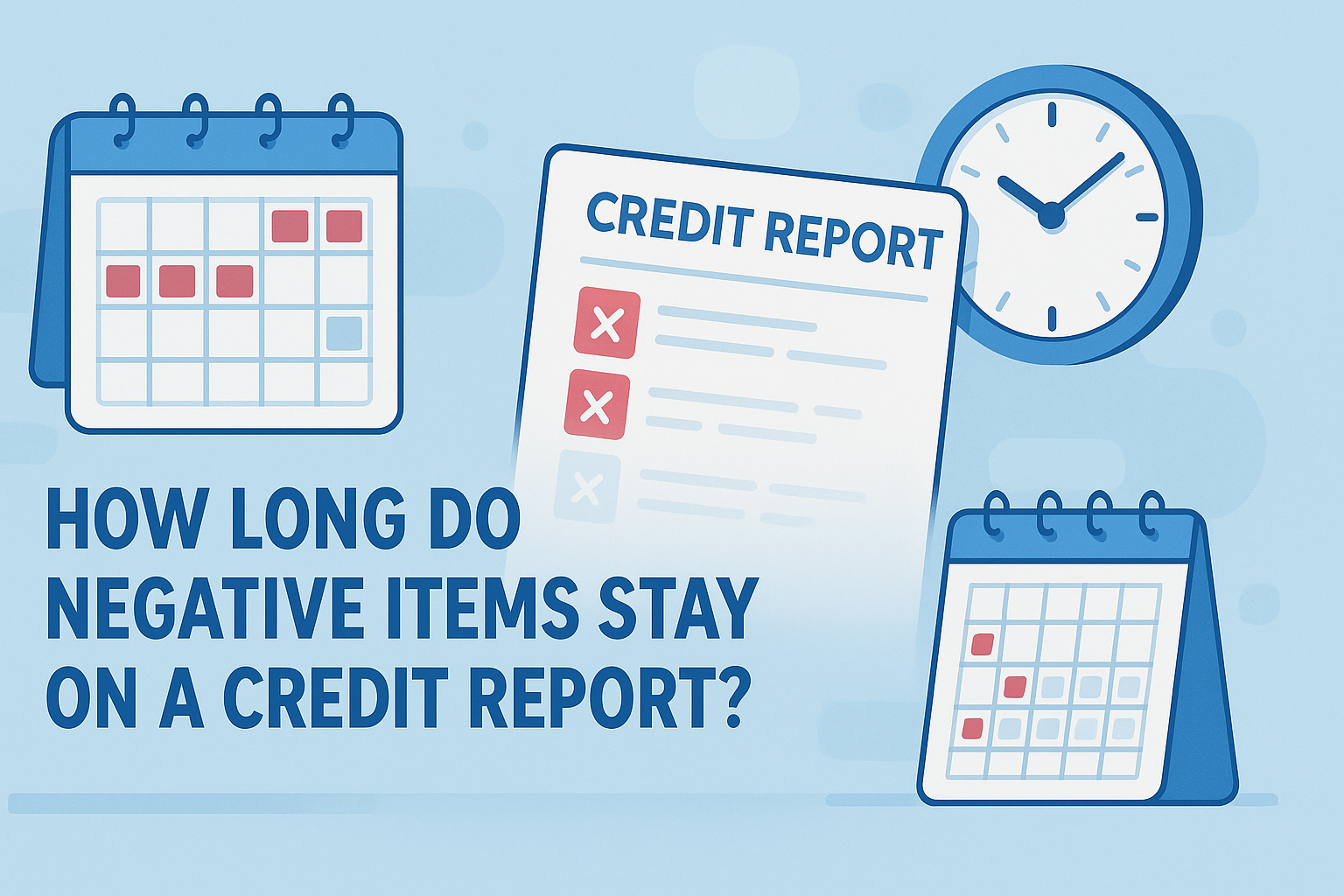
How Long Do Negative Items Stay on a Credit Report? (Explained for Beginners)

Written by MrHamza, Credit Score & Report Educator

Today question is How Long Do Negative Items Stay on a Credit Report? If you’ve ever messed up a payment or had a bill go to collections, you’ve probably heard the scary line:

“That’s going to be on your credit report for seven years.”

Cool. But… seven years from when?
And does that mean your score is ruined the whole time?
And what about bankruptcy — is that seven years or ten?

Let’s break all of this down in plain English.

In this guide, you’ll learn:

  • How long different negative items usually stay on your credit report
  • When the clock starts (this part is huge)
  • How long hard inquiries show up
  • How long good stuff stays
  • Why your score can start improving way before items actually fall off

All using timelines from the CFPB, FTC, and major credit bureaus like Equifax, Experian and TransUnion.

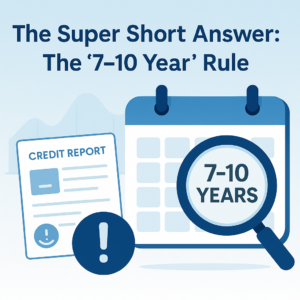
1. The Super Short Answer: The “7–10 Year” Rule

7–10 Year rule

According to the Consumer Financial Protection Bureau (CFPB) and the Federal Trade Commission (FTC):

  • Most negative information can be reported for up to 7 years
  • Bankruptcies can appear for up to 10 years
  • Hard inquiries (hard credit checks) show for up to 2 years
  • Positive accounts (paid on time, closed in good standing) can stay for up to 10 years and are actually helpful, not harmful

But the details matter, because not everything is exactly the same.

2. Quick Table: How Long Common Negative Items Stay

Here’s a simple “cheat sheet” you can add as a visual on your blog:

Type of ItemTypical Time on Credit Report (US)Notes
Late payments (30/60/90+ days)Up to 7 years from the date of the missed paymentImpact fades over time if you build new positive history
Collections (paid or unpaid)Up to 7 years from original delinquency date (first missed payment that led to collections)Paying can still help scores & future lenders
Charge-offsUp to 7 years from the date the account was charged off / original delinquencyYou may still legally owe the debt
Repossessions / ForeclosuresGenerally up to 7 years from original delinquency dateTreated as serious derogatory events
Civil judgments / lawsuitsAbout 7 years or longer if statute of limitations is longerMany are no longer widely reported, but rules can vary
Bankruptcy – Chapter 7Up to 10 years from filing date“Straight” bankruptcy, debt wiped faster
Bankruptcy – Chapter 13Often 7 years from filing, sometimes up to 10 years depending on bureau/policyYou repay some/all of the debt over time
Hard inquiriesUp to 2 years on your report; most scores only count last 12 monthsSmall impact compared to major negatives
Positive accounts (never late)Often up to 10 years after closure; open good accounts can stay indefinitelyThese help your credit history and score

Important: These are general rules based on federal law (FCRA) plus bureau policies. Individual situations or state laws can create exceptions, but this table covers what most US consumers experience.

3. When Does the “7 Years” Clock Start?

When Does the “7 Years” Clock Start

This trips a lot of people up.

For most delinquent debt (late payments, collections, charge-offs), the clock usually starts at the original delinquency date — the date you first fell behind and never fully caught up.

Example:

  • Your payment was due June 1, 2023
  • You never paid that payment
  • The account eventually went to collections

The “7-year” reporting period generally starts:

June 1, 2023 (when the bill first became delinquent and stayed that way)

Not when:

  • The debt was sold to a collection agency
  • The collector last called you
  • You made a small payment years later

The Wisconsin Department of Financial Institutions (and other regulators) give a similar example: late payments, collections, and charge-offs can be reported for no more than 7 years and 6 months from the date the debt should have been paid, counting from the original due date.

4. How Long Specific Negative Items Last (With Examples)

4.1 Late Payments – Up to 7 Years

If you’re 30 days or more late, your lender may report it as a late payment to the bureaus. That late mark can stay for up to 7 years from the missed due date.

But the impact on your score:

  • Hurts the most right after it happens
  • Gradually matters less over time if you go back to paying everything on time

Example

  • You miss a payment due March 10, 2024
  • It’s reported as 30 days late
  • That mark can stay until around March 2031

If you then pay on time for the next 3–5 years, many scoring models will treat that old late payment as less important — even though it’s technically still on your report.

4.2 Collections – Up to 7 Years from Original Delinquency

A collection account appears when a lender sends or sells your unpaid debt to a collection agency.

TransUnion says collection accounts — paid or unpaid — can stay on your report for up to 7 years.

The critical part: the 7 years usually runs from the date of the original delinquency that led to collections, not from when the collector bought the debt.

Paying a collection:

  • Doesn’t reset the 7-year clock
  • Can still help you in other ways — some newer scoring models treat paid collections less harshly, and many lenders like to see that you took responsibility

4.3 Charge-Offs – Up to 7 Years

A charge-off happens when a creditor basically says, “We don’t think we’re going to collect this, so we’re writing it off for our books.” You usually still owe the money, and it might get sold to a collector.

Experian notes that a charge-off can stay on your report for 7 years from the date the debt was charged off / original serious delinquency.

Like collections, charge-offs are:

  • Very negative at first
  • Still reported for up to 7 years
  • Less damaging over time if you stop adding new negative marks

4.4 Bankruptcies – 7 to 10 Years

Bankruptcy is one of the most serious negative events.

The CFPB states that bankruptcy can stay on your credit report for up to 10 years from the date of the order or adjudication.

FICO gives a more detailed breakdown:

  • Chapter 7 or 11 – often remain up to 10 years from filing
  • Chapter 13 – often removed after 7 years, though some bureaus may report up to 10 years depending on their policy

Even here, the impact softens over time:

  • The first couple of years after bankruptcy: big score damage
  • As you rebuild with positive accounts and on-time payments, your score can move up even before the bankruptcy falls off

4.5 Hard Inquiries – 2 Years (But Usually Only Count 1 Year)

When you apply for credit (card, loan, etc.), the lender often performs a hard inquiry.

Major bureaus and FICO/VantageScore explain:

  • Hard inquiries stay on your credit reports for up to 2 years
  • Most scoring models only factor them into your score for about 12 months
  • Their impact is small compared with late payments, collections, or bankruptcies

So if you’re stressing about a couple of hard pulls from a car loan or apartment hunt a year ago — they’re not your biggest problem.

4.6 Positive Information – Up to 10 Years (and That’s Good)

Not everything “staying on your report” is bad.

Experian notes that:

  • Positive entries and accounts closed in good standing can stay on your report for up to 10 years
  • That includes loans you fully paid off and credit cards you closed with no problems

These help you by showing:

  • Long history
  • Successfully repaid accounts
  • Responsible use of credit

So you want the positive stuff to stick around.

4.7 Special Case: Medical Debt (Right Now It Still Can Show)

Medical debt has been a moving target in 2024–2025.

  • The three big bureaus voluntarily stopped reporting paid medical collections, medical collections under $500, and medical collections less than one year old, starting around 2022–23.
  • In January 2025, the CFPB finalized a rule to remove all medical debt from credit reports used by lenders, an estimated $49 billion affecting about 15 million people.
  • But later in 2025, federal courts blocked and then vacated that rule, so medical debt can still appear on credit reports, except for the voluntary exclusions mentioned above.

Bottom line (late 2025):

  • Small medical collections and some paid ones may no longer show
  • Larger/unpaid medical debts can still appear and follow the same roughly 7-year reporting rule as other collections, depending on bureau and state law

5. Does “On Your Report for 7 Years” = “Score is Ruined for 7 Years”?

Score is Ruined for 7 Years

No. This is one of the most important mindset shifts.

Regulators and credit educators consistently point out:

  • Negative items can stay up to 7 (or 10) years
  • But their impact on your score decreases over time
  • Your score can start improving much sooner if you:
    • Pay on time from now on
    • Lower your credit card balances
    • Avoid new serious negatives
    • Build positive history

Think of it like this:

The first year after a big mistake is like the “storm.”
Years 2–7 are more like “cloudy with a chance of sunshine” as long as you change your behavior.

6. How to Tell If Something Should Have Already Fallen Off

Both the FTC and CFPB say: most accurate negative information must be removed after the legal time limits — generally 7 or 10 years, depending on the item.

So if you see:

  • A late payment older than 7 years
  • A collection account with a first delinquency more than 7+ years ago
  • A bankruptcy older than 10 years

…it may be time to dispute outdated information.

Steps:

  1. Pull all three reports (Equifax, Experian, TransUnion) via AnnualCreditReport.com. Equifax+2Experian+2
  2. Check the dates of negative items.
  3. If something seems too old:
    • Gather basic info (account, dates, any old letters if you have them)
    • Dispute with the bureaus, explaining that the item is beyond the allowed reporting period
  4. Bureaus generally have 30 days (sometimes up to 45) to investigate and correct if needed. TransUnion+1

7. Real-Life Example Timeline

How Long Do Negative Items Stay on a Credit Report

Let’s make this real with dates.

Example: Late Payment & Collection

  • You had a credit card payment due April 5, 2022.
  • You never paid it.
  • The account became severely delinquent, then went to collections in January 2023.
  • A collection account appears on your credit report in March 2023.

When does the 7 years start?

  • From the original delinquency date: April 5, 2022.

When might it fall off?

  • Around April 2029 (roughly 7 years from that first missed due date).

During those 7 years:

  • The negative will be visible on your report
  • But if you:
    • Pay other accounts on time
    • Keep your credit card balances low
    • Avoid new late payments or collections

…your score can improve significantly long before 2029.

8. What You Can Do Now (Instead of Just Waiting 7 Years)

You can’t magically erase accurate negative info before the time limits, but you can:

  1. Fix anything that’s wrong or too old
    • Dispute errors and outdated items with the bureaus. TransUnion+1
  2. Stop adding new negatives
    • Set up autopay or reminders for at least the minimum payment
    • Contact creditors early if you’re struggling to pay
  3. Attack your credit card balances
    • Lowering your utilization often gives noticeable score boosts even if you still have some old negatives. Experian
  4. Build positive history on top of the negatives
    • Keep one or two accounts open and in good standing
    • Consider tools like secured cards or credit-builder loans if you’re rebuilding
  5. Check your reports regularly
    • Catch new errors or fraud early
    • Track when older negatives are due to fall off

9. Key Takeaways (So You Don’t Have to Reread Everything)

If you only remember a few things, make it these:

You don’t have to wait 7–10 years to see improvement — if you start building good habits now, your score can recover while old negatives slowly age off.

Most negative items (late payments, collections, charge-offs) stay up to 7 years; bankruptcies up to 10 years.

The clock usually starts from the original delinquency date, not when a collector buys the debt or when you last got a call.

Hard inquiries are weak negatives: they stay up to 2 years, but scores often only count them for 12 months.

Positive accounts can stay for 10 years and help you. You want that history.

Leave a Comment