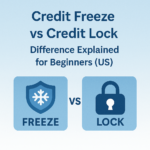
Credit Freeze vs Credit Lock: Difference Explained for Beginners (US)

Written by MrHamza, Credit & Identity Protection Educator

Today subject is about Difference between Credit Freeze vs Credit Lock If you’ve ever gotten one of those scary emails like:

“We’re writing to let you know your Social Security number may have been exposed in a data breach…”

…you’ve probably also heard:

  • “You should put a credit freeze on your file,” or
  • “Just turn on a credit lock in your app.”

They sound almost the same, but they’re not identical.

In this guide, we’ll break down in normal language:

  • What a credit freeze is
  • What a credit lock is
  • How they’re similar
  • The key differences that actually matter (cost, legal rights, protection level)
  • When to use freeze vs lock — and when a fraud alert might be better

All based on official guidance from CFPB, FTC, USA.gov, and the major credit bureaus.

1. The “One-Glance” Difference

One-Glance

Here’s the basic idea:

The Consumer Financial Protection Bureau (CFPB) is very blunt about this:

Credit locks are no more effective than security freezes, which are free and which you have a right to by law. Consumer Advice

So freezes give you strong protection + legal rights, locks add convenience + extra features (for a price).

2. What Is a Credit Freeze (Security Freeze)?

A credit freeze, also called a security freeze, is a tool that lets you restrict access to your credit report at a credit bureau. consumerfinance.gov+2banking.nh.gov+2

When a freeze is in place:

  • Most lenders can’t see your report
  • They usually won’t approve new credit in your name if they can’t check your report
  • That makes it much harder for identity thieves to open new accounts pretending to be you Consumer Advice+2transunion.com+2

Key facts (US):

  • You have a legal right to place a freeze under federal law. Consumer Advice
  • Since September 21, 2018, freezes and unfreezes are free nationwide, for adults and for children under 16 (through a parent/guardian). Consumer Advice+1
  • A freeze does not affect your credit score and doesn’t stop you from using your existing cards or accounts. Consumer Advice+1

You can temporarily lift (“thaw”) the freeze if you want to:

  • Apply for a credit card
  • Finance a car
  • Get a mortgage
  • Sometimes even when renting an apartment or getting a cell phone plan

You choose:

  • When to lift it (dates)
  • Or which creditor can access your report during a specific window (some bureau systems allow this)

3. What Is a Credit Lock?

What Is a Credit Lock?

A credit lock is a subscription-style service offered by credit bureaus and security companies that lets you “lock” and “unlock” your credit report — usually via an app or online dashboard.

Similarities to a freeze:

  • Goal is the same: block new-credit access to your report to help stop new-account identity theft. Consumer Advice+2Wikipedia+2
  • You must set it up separately at each bureau.

Differences from a freeze:

  • A lock is typically not a legal right, it’s a contract/service (terms & conditions apply). Consumer Advice+2Consumer Advice+2
  • Often part of a paid plan that includes monitoring, alerts, insurance, etc. Wikipedia+2Norton Support+2
  • Marketed as more convenient: you can lock/unlock with a toggle instead of going through the full freeze/unfreeze request.

The CFPB warns that credit locks are not more protective than freezes — they’re mostly about convenience and extras, not stronger security. Consumer Advice+1

4. Side-by-Side: Credit Freeze vs Credit Lock

Here’s a simple comparison you can use as a visual on your blog:

FeatureCredit Freeze (Security Freeze)Credit Lock
Main purposeBlock access to your credit report to prevent new accountsBlock access to your credit report to prevent new accounts
Based on…Federal law (FCRA) – a legal rightContract/service with a bureau or provider
CostFree to place and lift, nationwideOften part of a paid subscription
Where you set itEach bureau: Equifax, Experian, TransUnionEach bureau / provider’s app or portal
ConvenienceMay need to log in or contact bureaus to freeze/unfreezeUsually app-based toggle (lock/unlock)
For minorsParents/guardians can freeze a child’s credit under 16 for freeTypically adult-focused services
Legal protectionsSpecifically covered by federal law & disclosuresCovered by contract; fewer explicit statutory rules
Effect on credit scoreNo impact on your scoreNo impact on your score
What it blocksMost new-credit checks; lenders can’t pull your report normallySame goal: restricts new-credit access

Sources for the comparison: CFPB, FTC, USA.gov, and bureau education pages. Consumer Advice+4Consumer Advice+4Consumer Advice+4

5. Real-Life Example: Data Breach & Identity Theft

Credit Freeze vs Credit Lock

Let’s imagine:

  • Your Social Security number is exposed in a big data breach.
  • A fraudster uses your info to try to open a $5,000 store credit card.

If you do nothing:

  • The store pulls your credit report from a bureau.
  • They see a clean file and approve the card.
  • You only find out when bills or collection notices show up.

Now you’re dealing with:

  • Disputes
  • Potential credit score damage
  • Hours of phone calls and letters

If you have a credit freeze in place:

  • The store tries to pull your credit.
  • The bureau says, “Sorry, this file is frozen.”
  • The store usually denies the application, because they can’t run a proper check. Consumer Advice+2transunion.com+2

Same result if your credit lock is active and functioning properly — the request to view your report is blocked. Consumer Advice+1

Either way, the thief’s attempt hits a wall before they get the new account.

That’s why agencies like the FTC say freezes can be a very effective identity-theft defense, especially after a breach. Consumer Advice+2Consumer Advice+2

6. Special Case: Protecting Children’s Credit

One place where freezes clearly beat locks is children.

Federal law and FTC guidance say: ncsecu.org+4Consumer Advice+4Consumer Advice+4

  • Parents, legal guardians, and certain child welfare representatives can place a free credit freeze for children under 16.
  • This can be done even if the child doesn’t yet have a credit file — the freeze will create and then lock it. equifax.com+2transunion.com+2
  • The freeze stays until you lift it or until the child is old enough to manage their own credit. Consumer Advice+2files.consumerfinance.gov+2

This is huge because:

  • Child identity theft is a real problem — thieves love clean Social Security numbers. Consumer Advice+2consumerfinance.gov+2
  • Problems may not show up until your kid applies for student loans or their first apartment.

Credit lock services are mostly aimed at adults, and don’t give you the same clear, no-cost protection for minors that freezes do.

7. Where Does a Fraud Alert Fit In?

There’s a third tool that often gets mentioned with freezes and locks: the fraud alert.

A fraud alert is a notice on your credit report that tells lenders:

“Hey, this person might be a victim of fraud — verify their identity carefully before opening new credit.” equifax.com+2Consumer Advice+2

Key points:

  • It does not block access to your report like a freeze.
  • Instead, it forces lenders to take extra steps (like calling you) before approving new credit.
  • If you place a fraud alert with one major bureau, it must notify the others. equifax.com
  • Initial fraud alerts generally last 1 year; extended alerts (for confirmed identity theft victims) can last 7 years.

Think of it like this:

  • Fraud alert = “Proceed with caution and call me first.”
  • Freeze / lock = “Stop. You can’t access this at all unless I say so.”

Sometimes, the CFPB even suggests a fraud alert as an alternative if you don’t want the friction of constantly freezing and thawing, but still want extra protection. equifax.com+1

8. How to Place a Credit Freeze (High-Level Steps)

You must freeze with each bureau separately:

  • Equifax
  • Experian
  • TransUnion

Official government pages (FTC, USA.gov, CFPB) all point back to these bureaus as the place to request a freeze. Consumer Advice+3Consumer Advice+3transunion.com+3

Typical steps:

  1. Go to each bureau’s freeze page
    • Find “Security Freeze” or “Credit Freeze” on Equifax, Experian, TransUnion.
  2. Provide:
    • Full name
    • Address
    • Date of birth
    • SSN last 4 (or full in some cases)
    • Possible identity verification questions
  3. Choose:
    • Freeze now
    • Or lift for a specific date window or for a specific creditor (if offered)
  4. Save:

USA.gov has a simple overview page for how freezes work and how to lift them. transunion.com+1

9. How to Turn on a Credit Lock

Because a credit lock is a product, not a legal right, the process depends on:

  • Which credit bureau you’re using
  • Whether you’re using a third-party service tied into the bureaus

In general:

  1. You sign up for a paid plan (identity theft or credit monitoring package). Wikipedia+2Norton Support+2
  2. In their app or dashboard, you see a lock/unlock switch for each report they cover. Consumer Advice+2Consumer Advice+2
  3. You tap to lock your report and tap again to unlock when you’re applying for credit.

Pros:

  • Very convenient if you move a lot, apply for credit often, or just want something easy to toggle.

Cons:

  • You’re paying for something that you can already largely do with a free freeze.
  • Your rights depend on the terms of the contract, not a specific law designed just for freezes. Consumer Advice+1

10. When to Use a Credit Freeze vs Credit Lock vs Fraud Alert

Choose a credit freeze when:

  • You’ve been part of a data breach involving sensitive info (SSN, DOB). Consumer Advice+1
  • You’ve seen fraudulent accounts on your reports.
  • You want maximum protection for free and don’t mind logging in to thaw it occasionally.
  • You want to protect a child’s credit.

Choose a credit lock when:

  • You’re willing to pay for extra convenience and bundled features (alerts, monitoring, insurance, etc.). Wikipedia+2Norton Support+2
  • You apply for new credit fairly often and want a quick way to lock/unlock.
  • You understand that a freeze could do the same core job for free, but you like the UX.

Consider a fraud alert when:

  • You suspect you’re at risk of identity theft, but you’re still actively applying for credit and don’t want to keep freezing and thawing. equifax.com
  • You want lenders to double-check it’s really you instead of blocking all access.

You can use combinations, too:

  • Freeze + fraud alert
  • Lock + fraud alert

The main thing is: pick the tool that matches how often you apply for credit and how much risk you’re facing.

11. Quick FAQ: Credit Freeze vs Credit Lock

Q1: Do freezes or locks hurt my credit score?
No. Simply placing or lifting a freeze or lock does not affect your credit score. They control access to your report; they don’t change the data itself. Consumer Advice+2Consumer Advice+2


Q2: If I freeze my credit, can I still use my existing cards and loans?
Yes. A freeze only blocks new-credit checks. You can still use your current credit cards, auto loans, and other accounts as usual. Consumer Advice+1


Q3: Is a lock stronger protection than a freeze?
No. According to the CFPB, locks are no more effective than freezes. The big difference is cost and convenience, not strength. Consumer Advice+2Consumer Advice+2


Q4: Do I need to freeze/lock all three bureaus?
Yes, if you want full coverage. A lender might pull from any of the three major bureaus (Equifax, Experian, TransUnion), so you should set your freeze or lock with each of them. Experian+3Consumer Advice+3transunion.com+3

Q5: I have credit monitoring and alerts. Do I still need a freeze or lock?
Monitoring tells you when something already happened. A freeze or lock helps block new accounts from being opened in the first place. Many security pros recommend using both: monitoring + freeze. Consumer Advice+1

12. Final Takeaway (Simple Version)

If you want a one-line rule:

Use a credit freeze as your default, and only pay for a credit lock if you really value the app convenience and extra features.

Both are tools to stop strangers from opening new credit in your name.
But only the freeze is:

Available specifically to protect your kids, too

Free by law

Clearly defined in federal rules

Leave a Comment