Quick Answer
Every credit card has two key dates each month — and they are not the same thing:
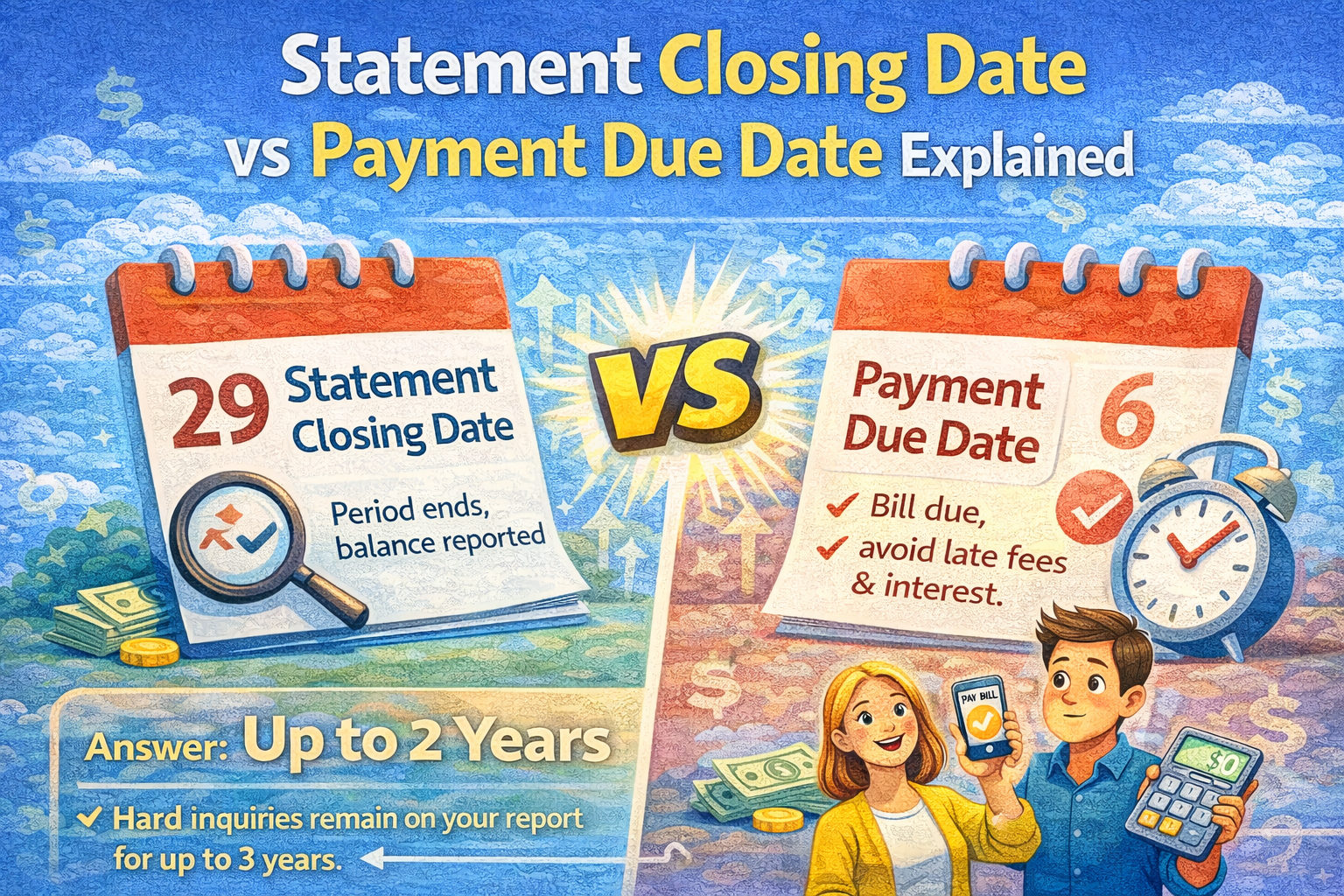
- Statement closing date: The last day of your billing cycle. This is when your bill is created and your balance gets reported to the credit bureaus.
- Payment due date: The deadline to pay that bill — at least the minimum — without a late fee.
Most people only watch the due date. But the closing date is what directly affects your credit score each month. Understanding both — and how they work together — is one of the most practical things a beginner can learn about credit.
The answer usually comes down to timing. Specifically, the difference between your statement closing date and your payment due date. These two dates serve completely different purposes, and mixing them up is one of the most fixable credit mistakes beginners make.
The Balances People Confuse
Before getting into the dates, it helps to understand the different balances you will see in your credit card app or statement. They each mean something slightly different.
Balances you will see in your app
- Current balance: What you owe right now — including any purchases made after the statement closed.
- Statement balance: What you owed at the end of your last billing cycle. This is what your bill is based on.
- Minimum payment: The smallest amount you can pay to keep the account in good standing for that cycle.
- Available credit: Your credit limit minus your current balance.
- Payoff amount: The full amount needed to bring your balance to zero, which may include accrued interest if it is already charging.
If you only remember one thing
If your goal is to avoid interest on purchases and your card offers a grace period, the number to focus on is the statement balance — paid in full by the due date.2
Cash advances and balance transfers often follow different interest rules. Always check your card agreement for those.
What Is the Statement Closing Date?
Your statement closing date — sometimes called the billing cycle end date — is the last day of your current billing period. On this date, the card issuer totals up everything you spent during that cycle and generates your monthly statement.
In simple terms: it is the day your bill is created.
What typically happens on or just after the closing date
- Your statement balance is set — this is the number your bill is based on
- Your minimum payment is calculated
- Your monthly statement (PDF or in-app) becomes available
- Your balance is often reported to the credit bureaus around this time — which means it can affect your credit score3
What Is the Payment Due Date?
Your payment due date is the deadline to pay at least the minimum payment shown on your statement. It is the date the card issuer uses to determine whether your payment was on time.
What happens if you miss it
- Late fees can be charged — even if you are just one day late
- Penalty APR may apply on some cards, meaning your interest rate could increase4
- Credit report harm typically begins when a payment is 30 or more days late — but fees and penalty rates can kick in before that
The 21-day rule
A federal timing requirement states that periodic credit card statements must be delivered at least 21 days before the payment due date shown on the statement.1 This rule exists to give cardholders enough time to review their statement and make a payment.
Simple way to remember the difference
| Date | What it does | Think of it as… |
|---|---|---|
| Closing date | Ends the billing cycle; creates the statement balance | The “meter reading day” — the bill is generated |
| Due date | Deadline to pay that statement | The “payment deadline” — the bill is due |
Why Both Dates Matter: 3 Real Reasons
1) Interest depends on the due date and your grace period
If your card offers a grace period on purchases, the standard way to avoid paying interest is to pay your statement balance in full by the due date.2 The grace period is the window between your closing date and your due date. Pay in full during that window and most cards will not charge you interest on purchases from that cycle.
Note: If you carry a balance from one month to the next, many cards will reduce or eliminate the grace period for purchases until you return to paying in full. Check your card agreement for exact terms.
2) Your credit score reacts to what gets reported around closing time
Credit utilization — the percentage of your credit limit you are using — is one of the bigger factors in most credit scores.3 Many card issuers report your balance to the credit bureaus around the statement closing date. That reported balance is what scoring models use to calculate your utilization.
This is the part that surprises most beginners: if your balance is high at closing, that high utilization gets reported — even if you pay the full amount off the very next day. The score impact is real, even if temporary.
3) Knowing both dates makes cash flow easier to manage
Once you know when your billing cycle closes and when your payment is due, you can align payments with your paycheck schedule, set autopay more precisely, and avoid the common mistake of assuming “autopay” covers the full balance when it might only cover the minimum.
Example: Why a Score Can Dip Even When You Pay in Full
- Credit limit: $1,000
- Closing date: March 10
- Due date: April 4
- Spending between March 1–10: $900
What happens step by step:
- On March 10, the statement closes — statement balance is set at $900.
- That $900 balance may be reported to the credit bureaus around this time, making your utilization look like 90% ($900 ÷ $1,000).3
- You pay the full $900 by April 4 — on time, no late fee, no interest charged (assuming a grace period applies).
- But the 90% utilization that was reported in March may already have affected that month’s score calculation — even though you paid in full.
- Once your issuer reports your lower balance in the next cycle, utilization drops and the score typically recovers.
In short: paying on time avoids late fees and interest. But it does not undo what was already reported at closing. The two outcomes are controlled by two different dates.
When Should You Pay? Match Your Goal to a Payment Approach
There is no single “right” payment timing for everyone. It depends on what you are trying to accomplish. Here are three common approaches:
Goal A: Avoid interest and late payments (good default)
- Pay the statement balance in full by the due date each month
- If autopay is available, set it to Statement Balance — not Minimum Payment. Most card issuers offer at least three autopay settings: Minimum Payment (the smallest required amount), Statement Balance (the full amount from your last bill — the safest choice for avoiding interest), and sometimes Current Balance (everything owed including new spending). Statement Balance is the right default for most people.
- Set a reminder 2–3 days before the due date to confirm the payment posted
Goal B: Lower your reported utilization before a credit application
- Pay down your balance before the statement closing date so a smaller balance is generated and potentially reported3
- Then pay any remaining statement balance by the due date as usual
- This approach is most relevant when you are planning to apply for a mortgage, auto loan, or new credit card in the near term
Goal C: You have a small limit or high monthly spending
- Consider making two payments per cycle — one mid-cycle and one just before the closing date — to keep the balance lower throughout
- Keep autopay active as a safety net for the minimum payment, even if you plan to pay more manually
Exceptions That Change the Rules
The general rules above cover most purchase activity on most cards. But there are a few situations where the rules work differently — and getting these wrong can be expensive.
-
- Cash advances: Many cards do not offer a grace period for cash advances the way they do for purchases. Interest on cash advances often begins accruing immediately. Always verify your card agreement before using this feature.
- Carrying a balance: If you do not pay your statement balance in full one month, many cards will reduce or remove the grace period on new purchases until you pay back in full. This means interest can start accruing on new purchases right away.2
- Reporting day varies by issuer: Not every issuer reports on the exact closing date. Some report a few days before or after. The safest approach is to keep your balance low throughout the cycle, not just on one specific day. If you want to confirm when your issuer actually reports, monitor your credit report for the date a new balance appears — that tells you when the data was sent.3
- Weekends and holidays: A payment submitted on a Saturday may not post until Monday. Paying 1–3 business days early reduces the risk of a technically on-time payment being recorded as late.
How to Find Your Closing Date and Due Date
Both dates are easy to locate — you do not need to call your card issuer.
- Your card’s mobile app or website: Most issuers display “Next closing date” and “Next due date” on the account summary screen
- Your monthly statement PDF: Shows the statement period start and end dates, the closing date, the due date, and the statement balance
- Account or billing settings: May show your billing cycle details and sometimes allow due date changes
Can you change your due date?
Many issuers allow cardholders to change their due date — usually within a limited range of dates. If your current due date falls before payday, moving it a few days later can reduce late-payment risk. This is often more practical than trying to time payments around the closing date for utilization purposes. Availability and limits vary by issuer, so check with your card provider directly.
FAQ
Is the statement closing date the same as the due date?
No — these are two separate dates with two different purposes. The closing date is when your billing cycle ends and your statement balance is set. The due date is the deadline to pay that statement. They are typically 21 or more days apart.1
If I pay right after the statement closes, does it help my credit score?
Not for that cycle. Paying quickly after closing is good for your finances, but the balance that was reported at closing has already been sent to the bureaus. To influence what gets reported for a given cycle, you need to pay down the balance before the closing date, not after.3
Should I pay the current balance or the statement balance?
To avoid interest on purchases when your card offers a grace period, paying the statement balance in full by the due date is typically the key target.2 The current balance includes purchases from the new billing cycle that are not yet due. Paying the full current balance is fine, but not necessary to avoid interest on the previous cycle’s purchases.
Why did my score drop even though I paid in full and on time?
This happens when the statement balance was high relative to your credit limit at closing — making your utilization look high when it was reported.3 Paying the balance off by the due date avoids fees and interest, but it does not erase what was already reported. Utilization typically recovers once the lower balance is reported in the next cycle.
How far in advance should I pay to be safe?
Paying 2–3 business days before the due date is a reasonable buffer for most payment methods. This accounts for weekends, holidays, and processing time. If you use autopay, verify the scheduled amount (statement balance vs. minimum) and the scheduled date at least a few days in advance.
Does every credit card have a grace period?
Not all credit cards offer a grace period, and terms vary by card agreement. Under federal consumer credit rules, if a card does offer a grace period on purchases, the card must give you at least 21 days from the statement closing date to pay before interest is charged on those purchases — this is the same rule that governs the minimum gap between your closing date and due date.1
If you carry a balance from a previous cycle, many cards will reduce or remove the grace period on new purchases until you return to paying in full.2 Always check your card agreement or the Schumer Box (the standardized fee and rate table on your card terms) to confirm your card’s specific grace period conditions.
What to Do Next
Start by finding your closing date and due date — both are available in your card’s app or on your most recent statement. Write them down or set a calendar reminder for each one so they stay on your radar each month.
If you currently only pay attention to the due date, that one change — also tracking your closing date — can make a real difference in how your credit utilization is reported month to month.
For most people, a simple default works well: set autopay to cover the full statement balance by the due date, and check in a couple of days early to confirm it posted. From there, the only adjustment worth considering is paying down your balance before closing if you are planning a credit application soon.
References
-
Consumer Financial Protection Bureau (CFPB). “Credit card statements and your rights” — covers the 21-day timing requirement between statement delivery and payment due date under TILA.
Source -
Consumer Financial Protection Bureau (CFPB). “What is a grace period for a credit card?” — defines grace periods, when they apply, and what causes them to be lost.
Source -
Experian. “What Is Credit Utilization?” — explains how balances are reported around statement close and how utilization affects credit scores.
Source -
Consumer Financial Protection Bureau (CFPB). “What is a penalty APR and when does it apply?” — covers penalty APR triggers including late payments.
Source
Disclosure: This article is general education, not financial advice. Issuer reporting practices, grace period rules, and credit scoring calculations vary by card agreement, lender, and scoring model. Always verify your exact terms before making decisions.